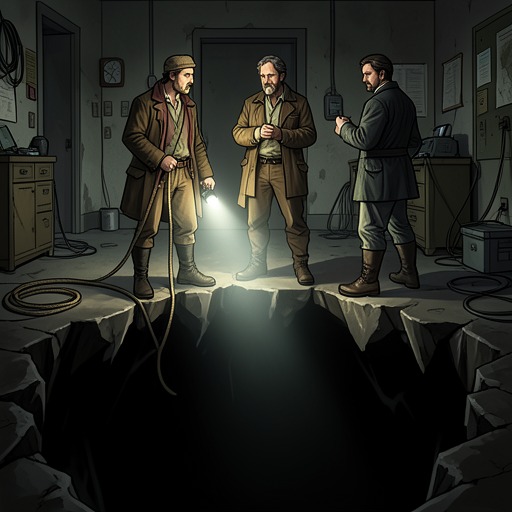
Kirby “Wax” Hook
House of LeavesKirby “Wax” Hook is the youngest member of Holloway Roberts’s team and its most conspicuous climbing prodigy. His trajectory moves from near-mythic physical confidence to violent injury and diminished possibility: the man who once imagined a solo ascent of Everest’s North Face is shot by Holloway in the labyrinth, survives only narrowly, and returns to outdoor life carrying a lasting fear of caves and enclosed spaces.
Identity and Background
Born in Aspen, Colorado, Kirby “Wax” Hook grew up among mountain faces and cave shafts. His technical aptitude appeared almost impossibly early: the account presents him as someone who understood pitons before he could walk and knots before he could speak. By the time he dropped out of high school, he had climbed more peaks than many climbers claimed in a lifetime. At twenty-six, he is the youngest member of the expedition, but his age does not imply inexperience; it emphasizes the startling speed with which he has made climbing his identity.
When Wax was twenty-three, Holloway Roberts hired him as a guide. For the next three years, Wax helped Holloway Roberts and Jed Leeder lead teams up Mt. McKinley, down into Ellison’s Cave in Georgia, and across a Nepalese cwm. The work paid little, but it provided the experience that mattered to him. His stated ambition was eventually to make a solo ascent of Everest’s North Face, a plan he expressed with the confidence of someone who regarded exceptional difficulty as a personal horizon rather than a warning.
Temperament and Expedition Role
Wax’s public persona is deliberately excessive. He drinks, pursues sexual encounters, and boasts about both, making his appetite for pleasure part of his performance before the camera and his companions. Yet the account draws a sharp boundary around his climbing. He does not boast about the mountains, because a rocky face is more powerful than the climber and survival depends on gratitude rather than mastery. This distinction gives his bravado a concealed discipline: what appears to be reckless self-display coexists with reverence for the environment that can destroy him.
His expertise also makes him a practical asset to Holloway Roberts’s expeditions. Together with Jed Leeder, he moves through difficult terrain and helps sustain the team’s exploratory work. Wax’s physical confidence contrasts with Jed Leeder’s shy endurance and uncanny sense of direction, while his relationship with Holloway Roberts is shaped by an older guide’s authority and a younger climber’s prodigious ability. That structure becomes unstable when the labyrinth begins to disrupt ordinary perception and memory.
The Shooting in the Labyrinth
After a cache has been stripped of its food and fuel, Wax and Jed Leeder find an intact jug of water near the entrance to an unexplored corridor. Wax drinks from it, and then returns for another swallow. At that moment, a rifle cracks. The shot drops him to the floor, with blood immediately pouring from his left armpit. The violence is especially shocking because the scene has not presented Wax as an opponent or aggressor; the expedition’s technical competence suddenly offers no protection against disorientation and friendly fire.
Jed Leeder immediately crouches beside Wax and applies pressure to the wound. Wax cries out for help and insists that he is bleeding, while Holloway Roberts emerges from the dark corridor holding the rifle. Holloway Roberts appears as startled by the sight of the two men as by the stairs themselves. He cannot explain how he arrived there and says that he believed he had encountered the thing in the house. The shooting therefore operates on two levels: it is a physical catastrophe for Wax and a revelation of the labyrinth’s power to fracture recognition, agency, and the distinction between teammate and threat.
Wax attempts to remain brave for the camera, forcing a smile despite his pallor. His repeated request for water becomes an indirect sign of shock, particularly because he has swallowed a large amount only moments earlier. The scene places his earlier confidence beside the body’s involuntary evidence of trauma: the climber who once treated danger as a demanding companion now struggles to conceal how close he is to collapse.
Survival and Physical Consequences
Kirby “Wax” Hook survives the shooting, but the aftermath is severe. He is transported by helicopter to a hospital in Washington, D.C., and placed in an intensive-care unit. Doctors discover that fragments from the coracoid process and scapular spine have mangled the trapezius, deltoid, and infraspinatus muscles. The bullet and bone fragments have only grazed the subclavian artery, making the narrowness of his survival part of the event’s meaning: a slight alteration in the bullet’s path could have converted a disabling wound into death.
Wax eventually recovers after a long period of rehabilitation and returns to outdoor activities. Recovery does not restore the future that preceded the shooting. It becomes doubtful that he will ever climb Everest, much less attempt the solo ascent of the North Face that had defined his ambition. His return is therefore incomplete: he regains activity but not the unquestioned physical destiny he once imagined.
Change and Narrative Significance
Wax’s later avoidance of caves, and even of his own closet, shows that the injury is psychological as well as muscular. The spaces associated with exploration have become reminders of entrapment, misrecognition, and the possibility that a familiar companion may suddenly become lethal. The cave is no longer merely an arena in which skill can be tested; it has become a condition of fear that follows him into ordinary domestic space.
His arc reverses the conventional adventure narrative. Wax enters the expedition as a near-superhuman specialist, equipped with exceptional experience and a dream of solitary ascent. He leaves it alive but permanently revised by forces that climbing ability cannot master. The labyrinth defeats him not by outclimbing him but by corrupting the social and perceptual framework on which survival depends. His survival is consequently both a reward and a punishment: he returns from the ordeal, yet the return carries the knowledge that neither the body nor the spaces it inhabits can be treated as reliably his own.